
 English
 Dutch
Dutch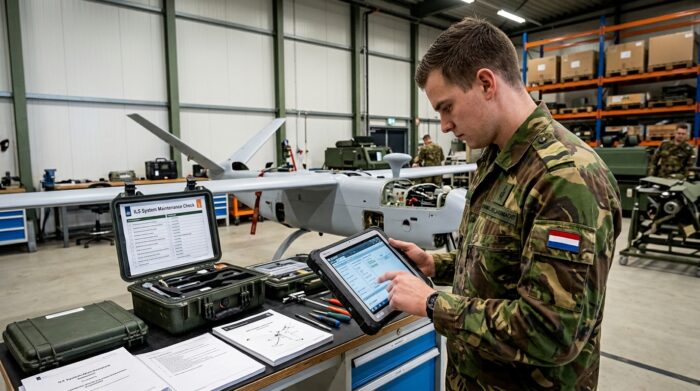
ILS within Defense
ILS within the defense and security sector is playing an increasingly important role. Defense works with complex systems, vehicles, installations […]

Read all about technology, strategy and operational readiness here
As an Asset Manager within Defense, you ensure that weapon systems, vehicles, ships, helicopters and other technical systems remain reliable, safe and deployable throughout their entire lifecycle. In this blog, we explain what Asset Management within the Defense and security sector involves, which responsibilities come with the role and why this position is becoming increasingly important. Curious about your opportunities in this field? View the vacancies at Talentmark Defense or contact us.
Asset Management within Defense focuses on the full lifecycle of military equipment. This starts with the acquisition of a new system and continues until the moment the equipment is taken out of service. Think of vessels, vehicles, UAVs, helicopters, weapon systems and other complex technical installations.
As an Asset Manager, you look beyond maintenance alone. You focus on availability, reliability, safety, costs and support throughout the entire lifecycle of a system. The key question is always: what is needed to keep this equipment ready for use, even under complex conditions? This makes Asset Management within Defense a combination of technology, planning, project management and collaboration. You work not only with technical specialists, but also with suppliers, maintenance organisations and operational users such as the navy, army or air force.
Defense will be investing heavily in people, resources and equipment in the coming years. The 2024 Defense White Paper states that the Netherlands is building a strong and smart armed force, which requires investments in Defense and a greater contribution from society. Statistics Netherlands also reported that Dutch defense expenditure in 2024 amounted to €19.9 billion according to NATO estimates.
More equipment also means greater responsibility for maintenance, sustainment and logistical support. New systems not only need to be acquired, but must also remain safe and effectively deployable for many years. A well-structured asset management process prevents systems from coming to a standstill due to missing parts, unclear maintenance plans or insufficient technical documentation. It ensures that maintenance becomes predictable, costs remain manageable and operational units can rely on the equipment they use.
Within Asset Management in Defense, you coordinate all activities needed to properly set up maintenance and support. You play an important role especially when new systems are acquired. You start by gaining insight into the system. Which components are critical? How is the system used? Where does maintenance take place? Which spare parts are needed? And what risks arise if certain components are not available?
Based on this insight, you work on concrete asset management deliverables, such as:
Throughout this process, you continuously consider the balance between cost, reliability and deployability. An Asset Manager therefore needs to be analytically strong, but also able to act pragmatically. The goal is not to create plans that only look good on paper, but to set up maintenance and support in a way that works in practice.
Within Talentmark Defense, the role of Project Lead Asset Management will often occur. In this role, you are responsible for leading working groups that set up maintenance and support for new equipment. These may be internal working groups, but also teams in which suppliers, specialists and users work together.
As a Project Lead Asset Management, you often act as a sub-project lead within a larger defense project. You report to the project lead and monitor planning, progress and quality. You ensure that the right people are involved, that decisions are made and that the required deliverables are completed on time.
The role therefore requires more than technical knowledge alone. You need to be able to plan, organize, influence and comunicate with different stakeholders. One day, you may be discussing maintenance strategies with technical specialists. The next, you may be coordinating with suppliers or operational users about training, spare parts or handover.
For a role within Asset Management, a higher professional or university-level working and thinking ability is usually required in a technical field, such as mechanical engineering, electrical engineering or a comparable study background. In addition, experience with asset management, maintenance management or engineering is important. Usually, at least three years of experience in an industrial or technical environment is required. Affinity with the maintenance domain is essential.
Additional knowledge can also be a major advantage, such as experience with project methodologies like Prince2, knowledge of SAP, Life Cycle Costing and Life Cycle Management. In terms of language skills, Dutch is usually required because you work within a Dutch defence context. English is important due to international suppliers, technical documentation and collaboration with partners. German may be an advantage in some projects.
Curious about your opportunities within Asset Management? View our open vacancies at Talentmark Defense or contact our team.
ILS within the defense and security sector is playing an increasingly important role. Defense works with complex systems, vehicles, installations […]

Working in the defense and security industry is more interesting for many people than they might initially think. Not only […]

The changing geopolitical landscape has led the Netherlands to significantly increase its investments in defense capacity. In addition to equipment […]